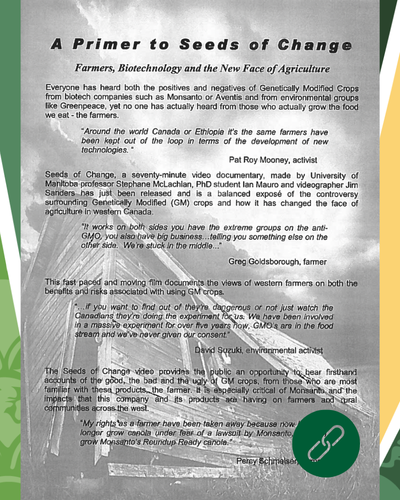
… If you want to find out if they’re dangerous or not, just watch the Canadians they’re doing the experiment for us. We have been involved in a massive experiment for over five years now. GMO’s are in the food stream and we’ve never given our consent .~ David Suzuki

Seeds of Change Documentary

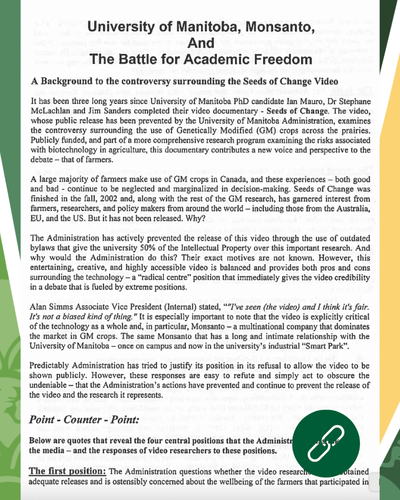
Seeds of Change is a groundbreaking 70-minute documentary that dives into the heated debate over genetically modified (GM) crops on the Canadian prairies. Created by University of Manitoba professor Stéphane McLachlan, PhD student Ian Mauro, and videographer Jim Sanders, this publicly funded film gives farmers a voice in a conversation often dominated by corporations and policymakers. Balanced yet bold, it explores both the promises and risks of biotechnology, offering a “radical centre” perspective in a polarized debate. Despite its completion in 2002, the film faced a three-year delay before its release in 2005 due to administrative restrictions—making its eventual unveiling a powerful moment for transparency and dialogue in agriculture.

Timeline of Long Anticipated Seeds of Change Release

The release of Seeds of Change, was deeply entangled in years of controversy and institutional resistance. Beginning in 2001 with publicly funded research proposals, the project quickly drew concern from the University of Manitoba over potential legal backlash from the biotechnology industry. Despite a completed film by late 2002, the University of Manitoba refused to release its copyright share, citing liability fears, which led to prolonged negotiations, legal hurdles, and mounting frustration. After years of stalled progress, public pressure and media scrutiny in 2005 finally compelled the university to yield, allowing the film’s long-awaited premiere at the National Farmers Union convention in Ottawa. Details surrounding the timeline can be viewed below.

2001

Research Proposals Submitted

McLachan submits research proposals for publicly funded farmer-focused risk analysis of genetically modified (GM) crops. Video outcome explicitly identified.

Spring & Summer 2002

Approval & Research Interviews

SSHRC and MRAC approve proposals and disseminate public funds for research. Researchers interview farmers and experts across Canada regarding GM crops.

Fall 2002

Film Completed & Partnership Arrangements

Rough edit of film complete. University of Manitoba enters into commercial partnership with outside distributor for worldwide release of video.

Fall 2002

University of Manitoba Administration Forecasts Lawsuits

University of Manitoba’s administration’s initial viewing of film causes concern about lawsuits from biotechnology industry; they indicate their insurance will not cover such claims.

Late Fall 2002

Requests to Transfer Copyright

Researchers express desire to release film and request that the University of Manitoba administration transfer its 50% copyright, which would enable public release of film.

Early Winter 2002

Film Release Blocked

University of Manitoba decides to not transfer 50% of copyright without indemnification and personal protection from researchers in case of potential lawsuits. These demands effectively block film release.

2003

Researchers Collaborate with Lawyer

Researchers spend the year working with entertainment lawyer to ‘legalise’ film in order to apply for external insurance, in hopes that this will pacify the University of Manitoba demands for protection against lawsuits.

Winter 2004

University of Manitoba Faces Financial Penalties

Researchers get external insurance quote for film estimated at $5000. University of Manitoba, distributor, and researchers meet to discuss. Investor upset with the University of Manitoba, and threatens to sue. The university pays investor back an estimated $28,000.

Fall 2004

Significant Challenges Hinder Film Release

The University of Manitoba officially drops support for project and will not agree to external insurance. They now demand indemnification, disassociation from researchers, and repayment for $28,000 in exchange for 50% copyright required to release film.

Spring 2005

Researchers Approach CAUT and UMFA for Support and Monsanto’s Relocates

Researchers’ lawyer recommends breaking off negotiations with the University of Manitoba, given excessiveness of demands. Researchers approach CAUT and UMFA for support in release of film. University of Manitoba announces relocation of Monsanto’s Canadian corporate headquarters to campus ‘SmartPark’.

Summer 2005

Researchers ‘Go Public’ Exposing Suppression of the Film

Researchers ‘go public’, exposing suppression of film

by the University of Manitoba administration. As the profile of the story grows in the media, the University of Manitoba administration decides lo reduce their demands, indicating so in a formal letter to McLachlan and Mauro.

Fall 2005

Researchers Free to Release Seeds of Change Publicly

Capitulation by the University of Manitoba administration frees the researchers to finally release Seeds of Change publicly. International premier takes place at the 2005 National Farmers Union Annual Convention in Ottawa.

Seeds of Change Film

Watch Seeds of Change to explore how it examines the biotechnology industry and its profound impact on modern agriculture. The film holds significant relevance for stakeholders around the world,whether activists, industry representatives, policymakers, or farmers.
For the first time, the risks associated with GM crops are evaluated through the perspectives and lived experiences of farmers themselves, the individuals most directly affected and the ones who should be central to this critical public policy discussion.

My rights as a farmer have been taken away because now I can no longer grow canola under fear of a lawsuit by Monsanto, unless I grow Monsantos Roundup Ready canola. ~ Percy Schmeiser, Farmer
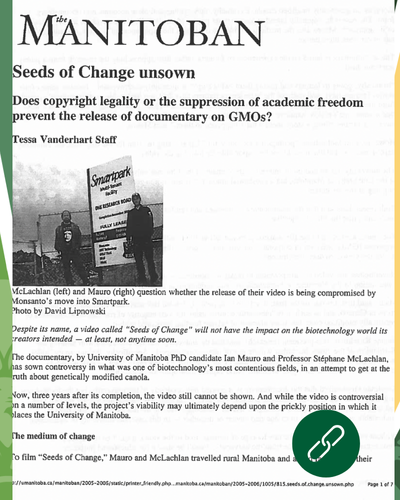
Seeds of Change in the Media